
Romero Leaves Field in Tears After Collision Deepens Spurs' Crisis
Authored by imm.ltd, Apr 15, 2026
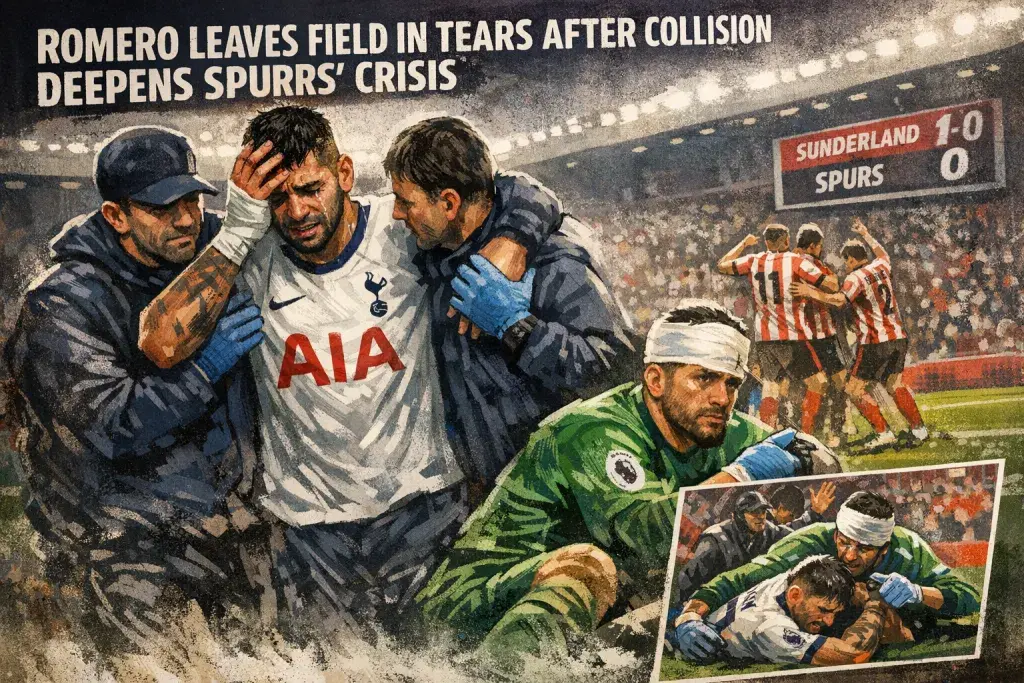
Cristian Romero, Tottenham's Argentine international defender, was carried off the field in visible distress on Sunday after a high-impact collision with his own goalkeeper, Antonin Kinsky, during a 1-0 defeat to Sunderland at the Stadium of Light. The incident, which unfolded in the second half and left both players requiring extended medical attention on the pitch, raises urgent questions about head and neck trauma protocols in elite football — and adds a painful new chapter to what has become a deeply troubled season for the north London club.
What Happened on the Pitch — and Why It Looked Serious
The collision occurred after Sunderland took the lead through a deflected Nordi Mukiele strike. Romero, attempting to recover a loose ball, appeared to be nudged by forward Brian Brobbey and lost his footing, sending him crashing into Kinsky at close range. The force of the impact left both players grounded. Sunderland midfielder Noah Sadiki immediately signalled for medical staff, and the atmosphere inside the stadium shifted noticeably as personnel attended to the pair for several minutes.
Kinsky, who had taken a blow to the head, was eventually cleared to continue after being fitted with a protective bandage — though backup goalkeeper Brandon Austin had been prepared to replace him. Romero was not as fortunate. Visibly shaken and in tears, the World Cup winner was helped to his feet and withdrawn from the action, unable to continue.
The emotional response from a defender known for his composure and physical resilience made the moment particularly striking. It was not performative distress — it was the reaction of someone acutely aware that something had gone wrong. Whether the tears reflected pain, disorientation, or neurological disturbance will only be clarified through medical assessment, but the optics were unmistakable.
A Pattern of Concern: Romero's Recent Medical History
Sunday's incident is not an isolated event. Just weeks earlier, Romero was substituted during a high-stakes European encounter against Atletico Madrid following a suspected concussion. That substitution was handled under the sport's concussion substitution protocols, which allow clubs to make temporary or permanent replacements when a head injury is suspected, without it counting against the standard quota of changes.
Two significant head-related incidents within the same season is not a trivial footnote. The medical literature on repeated concussive and subconcussive impacts is extensive: cumulative trauma to the brain, even when individual incidents appear minor, carries long-term risks that go beyond the immediate aftermath. Recovery timelines for head injuries are also notoriously difficult to predict. Unlike a muscular strain, where imaging and physical testing can provide relatively clear guidance, neurological recovery involves subjective symptom monitoring, cognitive assessments, and a degree of uncertainty that makes rushed returns genuinely dangerous.
For Romero personally, the priority will be thorough neurological evaluation before any return to physical activity is considered — regardless of how significant his absence proves for Tottenham's broader situation.
VAR, Defeat, and the Weight of the Table
The injury drama unfolded within a broader context of acute institutional pressure. Tottenham are currently in 18th position — inside the relegation zone — and Sunday was the first fixture under new head coach Roberto De Zerbi, who arrived with a considerable reputation built at previous clubs. It was not the beginning either party would have wanted.
The afternoon also featured a VAR controversy that further inflamed tensions. Referee Rob Jones initially awarded Tottenham a penalty after Randal Kolo Muani appeared to be fouled by Omar Alderete and Luke O'Nien. Jones reviewed the footage at the pitchside monitor and reversed his decision, drawing a furious response from the visiting bench. Whatever the technical merits of that call, its effect was to extinguish what had felt like a potential turning point.
Mukiele's deflected goal, which beat Kinsky at the near post, ultimately stood as the only meaningful moment of attacking quality on the day. The defeat leaves Tottenham two points below the safety threshold with significant uncertainty now surrounding one of their most important defensive figures. The next fixture — at home against De Zerbi's former club Brighton — takes on even greater weight under these circumstances.
The Broader Issue of Head Injury Management in Professional Football
Romero's situation inevitably returns attention to how head injuries are identified and managed at the highest level of the sport. The introduction of concussion substitutes was a significant step forward, but critics have long argued that the pressure to return injured players to action — particularly those deemed indispensable — creates a structural conflict of interest between medical and competitive priorities.
Clubs are not incentivised to be cautious when relegation is a genuine possibility. Defenders of Romero's quality are not easily replaced, and the temptation to rush a return, or to accept a player's own insistence that he is fit, remains a systemic risk. Governing bodies and club medical departments have made progress in recent years, but the gap between written protocol and pitch-side reality has not entirely closed.
What happens next with Romero will be watched closely — not only by Tottenham supporters, but by those who track how seriously professional football treats the long-term health of the individuals who make it possible.